companies
Testonica

Since 2005, we help our customers to design and test various electronic products. Our Quick Instruments framework, dedicated to the testing of FPGA-based PCBAs already keeps everyday costs down for many high-end customers around the globe, including leaders of industries like telecom, automotive, aerospace, defense, video processing, medical and more.
Quick Instruments
Test framework for FPGA board quality control
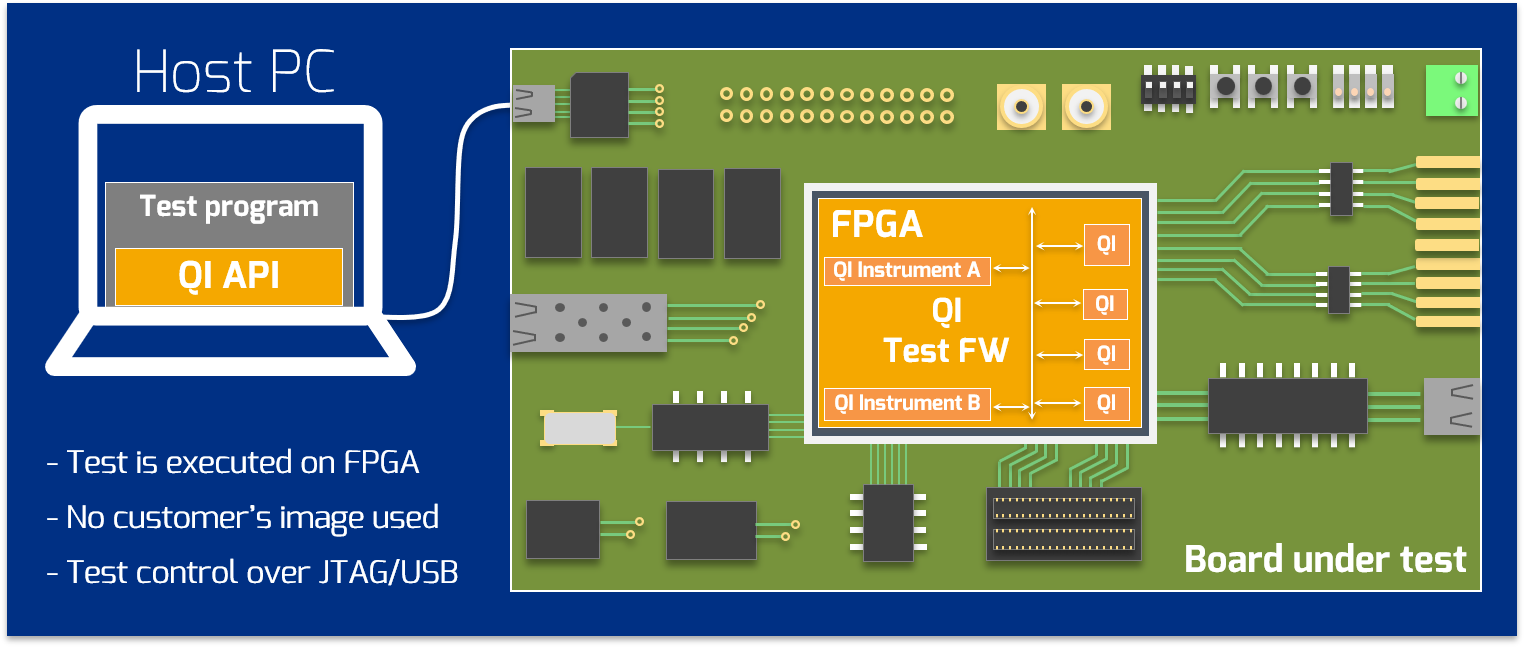
Quick Instruments (QI) is a test & measurement framework that loads itself into on-board FPGA for test, validation or programming purposes. The role of instruments is to verify PCBA hardware infrastructure: on-board interconnections and communication with peripheral components. In this way, every PCBA board can be checked for defects and stability issues. All instruments are pre-compiled for a target board and are being executed from test platform using predefined templates.
QI Toolbox
Transition from crafting to automation
Although every FPGA-based product has its own application, all PCBAs have a similar HW structure. They contain many typical components, like oscillators, SPI flashes, DDR memories, Ethernet PHYs, high-speed links, etc. The test of these ICs and communication buses can be standardized and fully automated. For each category of peripheral components, there is a particular test or measurement embedded instrument. You may think of embedded instruments as traditional instruments: signal generators, oscilloscopes, etc., but imagine them placed inside the board under test, inside the FPGA.
| Component | Instrument |
|---|---|
| Oscillator | Frequency Counter |
| DDR Memory | Memory Tester |
| SPI Flash | Flash Programmer |
| SERDES links | Bit Error Rate Tester |
| Ethernet PHY | Ethernet Tester |
QI test firmware and application firmware synergy
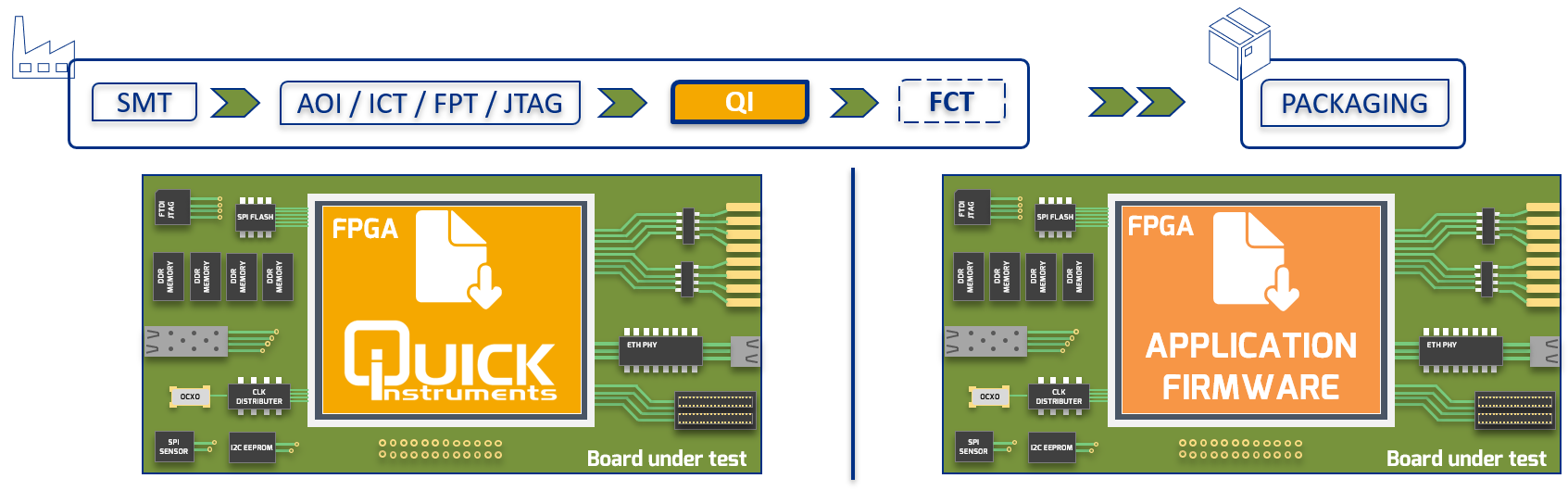
QI test firmware is used only temporarily during production / prototype / troubleshooting stage. It will populate the board when it is fresh (when it is just produced). QI test firmware runs on bare metal and will do just the testing and the diagnosis. It is not going to stay on a board when the board leaves an EMS factory. It will erase itself, so the user firmware (application firmware) will stay and will be shipped to the end customer. Normally, the QI test firmware loads the user's application firmware into the board as a last step on a production line.
Testing external interfaces
Some target devices are on a board under test and are directly addressable by instrumentation. But some others are just interfaces to the external world. Simple I/O connectors, Ethernet links and high-speed interfaces, like LVDS, SMA, SFP or PCIe are some common examples. A matching board or as simple techniques as looping back some buses or adding some external testers (or matching boards) is the way to get complete coverage.
Turn any FPGA-based board into a functional tester
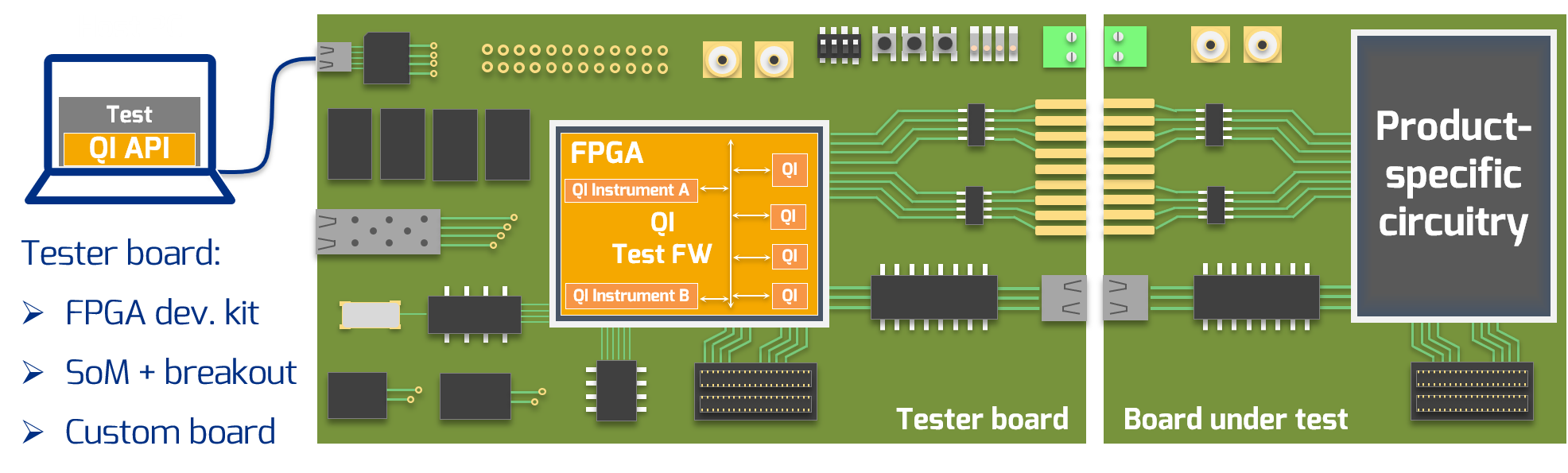
Contrariwise, a simple board or adapter board can be tested with the help of Quick Instruments. Since QI can be compiled for running on any FPGA-based board, it is straightforward to convert such a board into an external functional tester. Some use cases / UUT examples:
- Components on a board under test with external connections via I/O or testpoints
- Backplanes, adapters (PCB lines are tested), cables
- Extension board with digital interfaces to DAC/ADCs, PHYs and optical channels
- External flash programming via I/O lines
- Generating static or a clock signal on one side and catching on another
Key Features
- Every test engineer and product manager knows how much time is often required to localize the problem. Sometimes it takes hours, sometimes days or even months to find the root cause. It is even worse if the product is already coated and packaged when you detect the failure.
- Using Quick Instruments, you can test the board component by component and gigabit links - line by line. In case of a failure, you know exactly which communication bus or line does not work properly. This considerably shortens the searching area and streamlines the repair. The important aspect is that this information is available before the board has left EMS production facilities and product owner does not receive defective PCBAs.
- All our instruments are pre-developed, fetched from the off-the-shelf instrumentation library and compiled for a particular board under test using our back-end compilation servers. As a result, ready-to-use test firmware is available in just half a day. You don't need an application firmware, no FPGA design tools and knowledge required.
- All our tests are optimized for short test duration and can be executed during the end-of-line manufacturing tests. The instruments are working in the same conditions which a board designer planned and in the same way as the FPGA designer will run the application. Standard test techniques like ICT, Boundary Scan, and Flying Probe in many cases are not capable to verify high-speed interfaces and components on a bare board with an FPGA. With Quick Instruments, tests are executed at full functional speed (at-speed testing).
- By its nature, Quick Instruments is a software product. Being embedded to the FPGA logic and by applying the test from the inside, Quick Instruments have a set of unique advantageous features: an access to internal on-board signals, no need for testpoints and nails, no signal integrity issues.
- Almost no price for a duplicate. You can scale the number of production lines and you only need a USB-to-JTAG cable.
- No need for maintenance or calibration, no degradation in performance (can't outdate).
- Easier logistics: virtual Instruments that can be sent over email, copied and backed up.